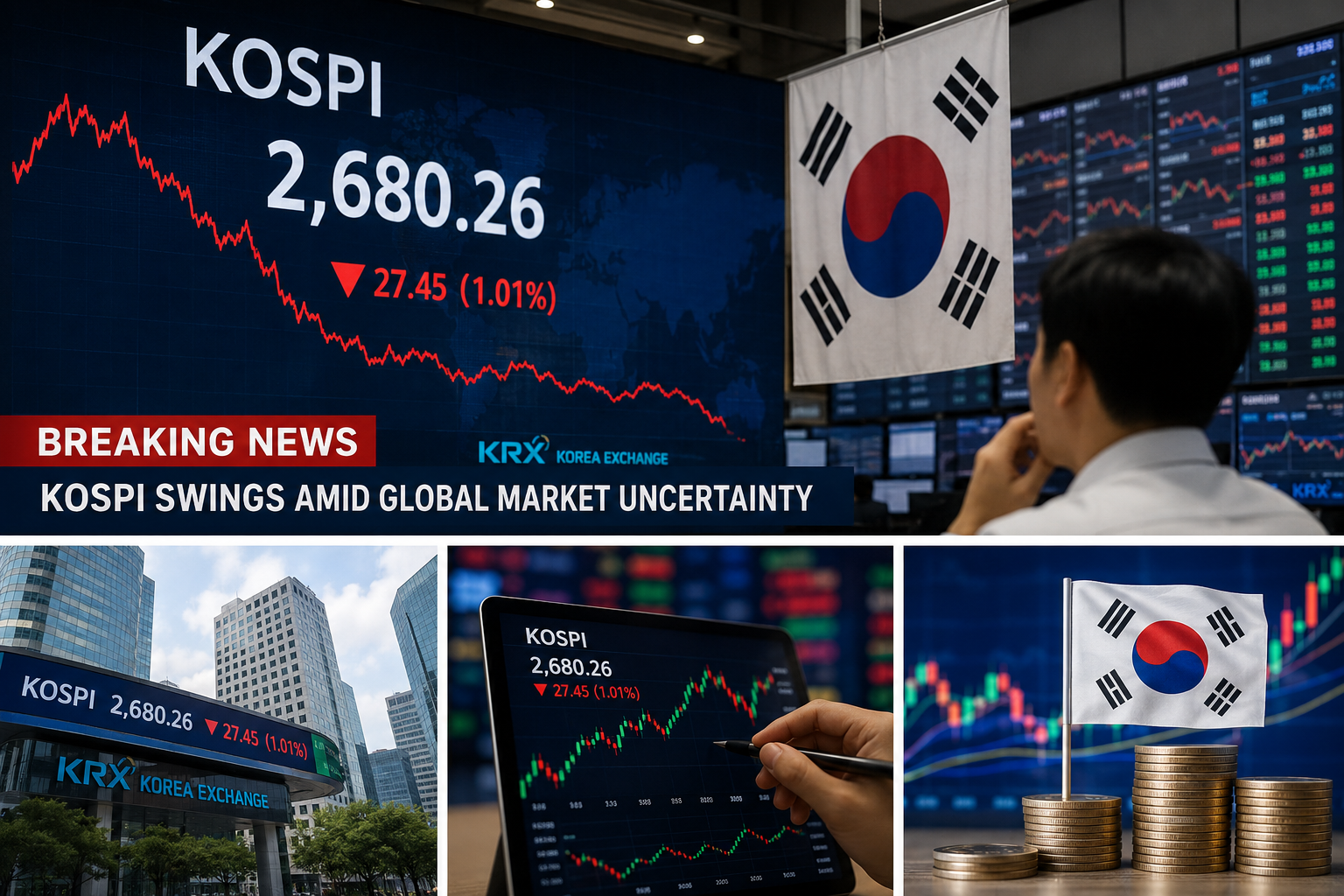
South Korea’s benchmark KOSPI Index experienced notable volatility during today’s trading session, reflecting growing investor caution as global financial markets reacted to fresh economic developments, shifting interest rate expectations, and mixed corporate earnings.
Market participants closely monitored movements across Asian exchanges after overnight fluctuations on Wall Street added uncertainty to investor sentiment. While technology and semiconductor stocks attempted to support the benchmark, selling pressure in several heavyweight sectors limited overall gains.
Investors Focus on Global Economic Signals
Trading activity remained active throughout the session as investors assessed multiple international developments influencing market direction. Expectations surrounding central bank policy, inflation trends, and global trade continued to dominate investor discussions.
Foreign institutional investors showed selective buying in large-cap technology companies, while domestic investors maintained a cautious approach amid ongoing market uncertainty.
Analysts noted that volatility is likely to remain elevated as traders wait for additional economic data expected later this week.
Technology Stocks Continue to Drive Market Sentiment
South Korea’s technology sector once again played a crucial role in determining the direction of the KOSPI. Semiconductor manufacturers attracted investor attention following renewed optimism surrounding artificial intelligence demand and improving global chip sales.
However, gains in technology shares were partially offset by weakness in consumer, industrial, and financial stocks, creating a mixed performance across sectors.
Market experts believe that continued demand for AI-related hardware could provide medium-term support for leading South Korean technology companies despite short-term fluctuations.
Asian Markets Trade Mixed
Elsewhere in Asia, major stock indices delivered mixed performances as investors balanced optimism over corporate earnings with concerns about slowing global economic growth.
Regional markets reacted to:
- Expectations regarding future interest rate decisions.
- Currency market fluctuations.
- Commodity price movements.
- Fresh economic indicators from major economies.
The broader market remains highly sensitive to global macroeconomic developments, making daily trading conditions increasingly unpredictable.
What Investors Should Watch Next
Financial analysts believe upcoming economic releases could become the next major catalyst for Asian equity markets.
Key factors likely to influence the KOSPI include:
- Central bank policy announcements.
- Inflation reports from major economies.
- Corporate earnings from leading technology companies.
- Foreign institutional investment flows.
- Currency movements, particularly the Korean won against the US dollar.
If global sentiment improves, the KOSPI could see renewed buying interest. However, persistent uncertainty may continue to trigger short-term volatility.
Market Outlook
Despite recent fluctuations, analysts remain cautiously optimistic about the long-term outlook for South Korean equities. Strong fundamentals within the semiconductor industry, continued investment in advanced technologies, and resilient export performance could provide support over the coming months.
Investors are nevertheless encouraged to remain selective, monitor global economic developments closely, and maintain diversified portfolios while navigating ongoing market uncertainty.
About the Author