
The terrain of Indian sports has evolved into a contested field of public opinion, political
interests, and athlete discontent, largely facilitated through the immediacy of social media. This
activism has moved beyond cricket and has emerged up in wrestlers’ challenges to national
identity, as well as exposing corruption in organisations and athlete longevity.

Cricket: The Geopolitical Battleground
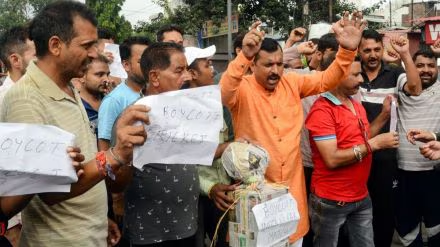
The rivalry between India and Pakistan remains the single most significant prompt for public and
political agitation (especially in sports). The 2025 Asia Cup was a dramatic manifestation of how
off-field tensions supersede sporting etiquette. The Indian team’s “No Handshake Policy,”
implemented as a show of political solidarity in the wake of terrorist aggression in Pahalgam,
was immediately proclaimed by nationalist writers on social media as a “strong statement” of
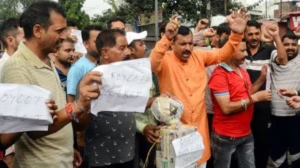
patriotic obligation. Simultaneously, this action escalated organized calls to boycott by
opposition parties and some sectors of the public, feeling incapable of participation, while
playing against Pakistan was conceived as an affront to national sentiment. How the
subsequent refusal by India to receive the trophy from a Pakistani representative was framed in
and of itself, with India opting against commemorating their victory as a sporting gesture of
reconciliation, was the primary focus of the online outrage and political posturing for weeks –
plainly demonstrating victory’s symbolism is presently more important than the sporting etiquette
of reconciliation.
Athlete Welfare: Protests Against Federation Corruption
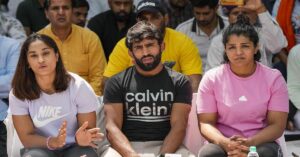
Besides the framework of bilateral rivalry, social media activism has become the dominant
method for exposing and combating the entrenched corruption and patronage running rampant
in National Sports Federations (NSFs). The crisis of politicization in NSFs–where officials or
politicians without any substantial sports background determine the allocation of resources and
which athletes are selected–has been brought to the forefront and challenged by athlete
protests.
Both the Supreme Court and various High Courts have reflected on corruption and nepotism as
two of the primary barriers to success in Indian sport. Athletes and activists have highlighted
issues surrounding transparency, fairness in selection, and even financial wrongdoing through
social media platforms such as X or Instagram, building popular support around an issue that
goes unnoticed and unaddressed using formal channels. The power of social media has
compelled coverage by satisfied and in some instances, even dominating the engaged media
space, and an important athlete protest of India’s top wrestlers occurred across the country
against the head of their federation and involved serious accusations of sexual harassment.
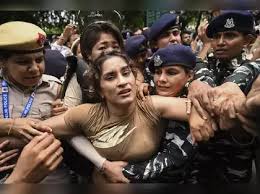
Visual images of elite athletes protesting against the federation in downtown public spaces
communicated an unassailable message of governance failure as well as calls for responsibility
from the government.
International Sanctions and Olympic Ambitions
The combination of sports and politics occurring through social media affects India’s plan to
enhance its global reputation and bid to host the 2036 Olympic Games. The critics of the Indian
government caution that when the government tampers with sport-related
decision-making—such as the “no handshake” proclamation—it will violate the Olympic Charter,
which asserts the autonomy of sport federations. Additionally, past incidents of the Indian
government restricting Pakistani athletes from travelling to a World Cup in Delhi resulted in the
international governing body stripping the event of qualification for the Olympics. Political
interference takes place through social media and within minutes, as the incident becomes
global and sheds India’s reputation as a reliable, apolitical host of events. Social media activism
produces a sense of urgency for domestic stakeholders to place the welfare and opportunities of
athletes ahead of political justification.
The Digital Double-Edged Sword
Social media is a double-edged sword: it provides athletes a pathway to circumvent corrupt
officials and reveal injustice while also contributing to the intensity of nationalism, resulting in
boycotts and violent interactions. Much of this is driven by the media, which transforms players
into political representatives who are made to feel pressure to win as a national form of
validation. In the end, the constant digital gaze has made the most basic failures of governance
and overreach of state capital practically impossible to escape, producing an atmosphere of
heightened emotions where every sport becomes an assessment of political will, integrity, and
the suffocating notion of national unity.
About the Author


8 thoughts on “The Political Scoreboard: Activism and Outrage in Indian Sports- Sharan G”
Comments are closed.