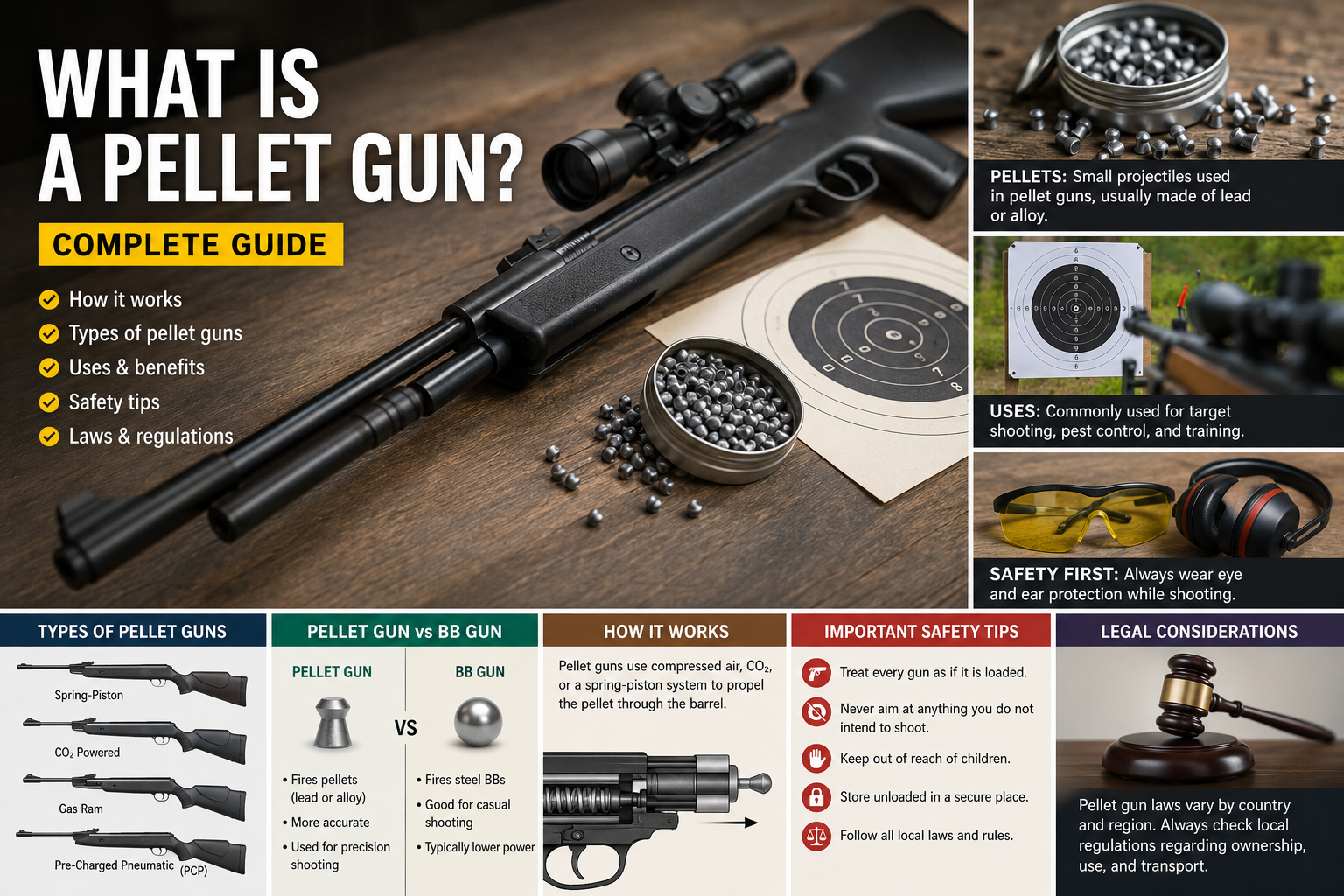
As interest in recreational shooting, pest control, and target practice continues to grow, many people are asking one important question: What is a pellet gun? Whether you’ve seen one online, heard about it in the news, or are considering buying one for sporting purposes, understanding how pellet guns work is essential.
Unlike traditional firearms, pellet guns use compressed air or gas to fire small metal pellets. While they are often considered less powerful than conventional guns, they are still capable of causing serious injuries if handled carelessly.
Here’s everything you need to know.
What Is a Pellet Gun?
A pellet gun is a type of air gun designed to shoot small pellets, typically made of lead or alloy. Instead of using gunpowder, pellet guns rely on compressed air, carbon dioxide (CO₂), or a spring-piston mechanism to propel the projectile.
Because they don’t use explosive ammunition, pellet guns are classified differently from firearms in many regions. However, ownership and use are still regulated by local laws.
How Does a Pellet Gun Work?
Pellet guns use one of several power systems:
- Spring-Piston: A spring compresses air to launch the pellet.
- Gas Ram: Uses compressed gas instead of a traditional spring.
- CO₂ Powered: Operates using replaceable carbon dioxide cartridges.
- Pre-Charged Pneumatic (PCP): Stores compressed air in a reservoir for consistent performance.
Each system offers different levels of power, accuracy, and maintenance requirements.
Common Uses of Pellet Guns
Pellet guns are widely used for several legitimate purposes:
- Target shooting
- Competitive shooting sports
- Skill development for beginners
- Small pest control where legally permitted
- Recreational backyard practice in approved locations
Many shooters prefer pellet guns because they generally produce less noise and have lower operating costs than traditional firearms.
Pellet Gun vs BB Gun
Although the two are often confused, there are important differences.
| Pellet Gun | BB Gun |
|---|---|
| Fires lead or alloy pellets | Fires steel BBs |
| Usually more accurate | Better suited for casual shooting |
| Available in higher-powered models | Typically lower power |
| Common for precision target shooting | Often used for recreational plinking |
Choosing between the two depends on your intended use and local regulations.
Are Pellet Guns Dangerous?
Yes. Even though pellet guns are not traditional firearms, they can cause serious injuries, including eye injuries, broken skin, and damage to internal organs.
Safety should always come first.
Essential Safety Tips
- Always treat every pellet gun as if it is loaded.
- Never point it at another person or animal unless legally permitted for lawful purposes.
- Wear proper eye protection.
- Store it unloaded in a secure location.
- Keep pellet guns away from children without adult supervision.
- Use only in safe and legal shooting environments.
Are Pellet Guns Legal?
Pellet gun laws vary widely depending on your country, state, or region.
Some places allow adults to purchase them freely, while others require permits, impose age restrictions, or regulate transportation and public use.
Before purchasing or using a pellet gun, always check the laws that apply in your area.
Advantages of Pellet Guns
Some of the benefits include:
- Lower operating costs
- Good accuracy
- Reduced recoil
- Less noise than many firearms
- Suitable for target practice and training
Disadvantages
Potential drawbacks include:
- Limited range compared with firearms
- Can still cause severe injuries
- Regular maintenance may be required
- Legal restrictions vary by location
Frequently Asked Questions
Is a pellet gun considered a firearm?
Not always. The legal classification depends on local laws and regulations.
Can a pellet gun be used for self-defense?
While some people consider it, pellet guns are generally not recommended as self-defense tools because their effectiveness and legal treatment vary. Always follow applicable laws.
Can pellet guns injure someone?
Yes. A pellet gun can cause serious injuries if used improperly.
What is the typical range of a pellet gun?
Manufacturers design many pellet guns for accurate shooting at short to moderate distances, although the effective range varies by model and power source.
Final Thoughts
Pellet guns have become increasingly popular for recreational shooting, target practice, and sports. Always treat pellet guns as serious equipment, not toys. Responsible ownership, proper safety practices, and compliance with local laws are essential.
If you’re considering purchasing a pellet gun, take time to research the different types, understand your local regulations, and choose a model that matches your intended purpose.
About the Author