Dussehra, the festival of the triumph of Lord Rama over Ravana, is not merely symbolic in
Bollywood’s embrace of celebration, but a brilliant cinematic convention. By contextualizing a
pivotal scene, whether it be a romantic reconciliation, a moral epiphany, or a violent revenge,
with the fiery spectacle of the Ravan Dahan (effigy burning) provides the audience is provided
with profound cultural and ethical significance. Dussehra serves as a rich, non-verbal signifier,
linking the agent’s personal struggle with cosmic ultimate justice.

The Defining Image of Moral Victory: Bajrangi Bhaijaan
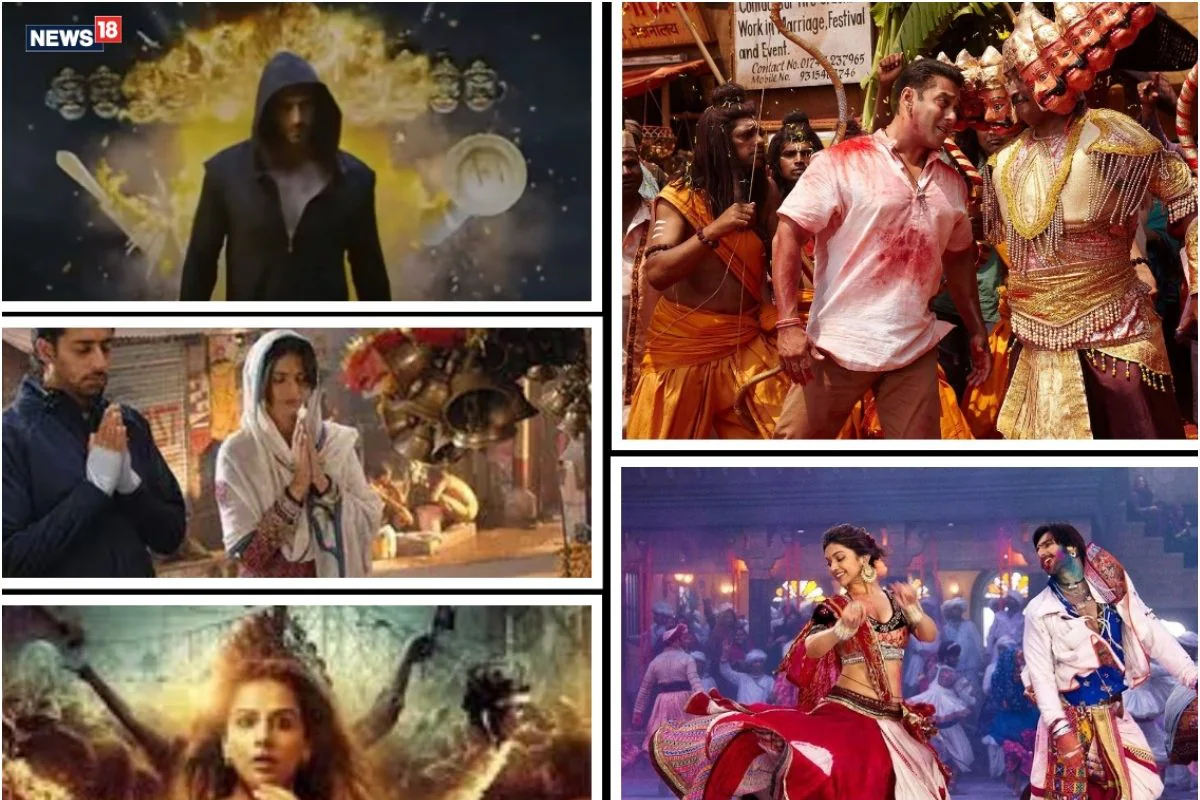
In the profoundly impactful Bajrangi Bhaijaan by Kabir Khan, the Dussehra event occurring
during the song “Tu Chahiye” is used for real emotional symbolism, rather than spectacle. In the
scene, the audience sees Salman Khan’s character, Pawan, observing the festivities of the
Ramleela. The instant a child dressed as Ram burns the effigy at the very moment the
Ramayana triumphant moment is symbolized. This moment encapsulates the ultimate meaning,
which is the goodness of innocence, and humanity is victorious over the evil of politics,
prejudice, and borders. Here, the Ravan Dahan serves as the moral arbiter of the story,
endorsing Pawan’s selfless act of reconnection with Munni’s family. The adoption of the event
achieves the effect of uplifting the story from a simple cross-national road trip to a sacred
mission of universal goodness, using a culturally significant story from a festival that dramatizes
the continued victory of dharma (righteousness) in a fractured world.

The Spectacle of Modern Chaos: Brahmāstra
Ayan Mukerji’s Brahmāstra utilizes Dussehra to display a sense of scale and energy, as well as
to signify the start of the hero’s journey as part of the film and Hindu myth. The sequence
involving the song “Dance Ka Bhoot” is visually vast, marketing a modern, urban festival. A
scene arrives where Ranbir Kapoor’s character, Shiva, dances with extravagant joy during this
festival, as the giant effigy sets the stage for the destruction of otherness. At this moment, the
festival transcends ancient lore, representing the modern conflict and triumph of light over the
“darkness” that comprises the film’s adversaries. The stunning visual of burning Ravana
operates as an aesthetic experience and layered discovery, as it not only celebrates thrilling
cinema but also foreshadows Shiva’s entry into life-altering opposition, wherein he must
extinguish evils associated with contemporary nature. The root of this experience exists within
the pairing of brahmāstra descriptions and identifying features, with feelings of antiquity, fused
with Bengali national identity, clashing with a modern representation of order versus chaos
expected in Western fusion. Overall, this powerful cinema presents a thoughtful spectacle, while
able to connect culturally, embedded within a familiar celebratory event.

Dussehra as a Weapon: Revenge and Retribution
Filmmakers frequently subvert the festival’s conventional message of spiritual cleansing by
engaging in violent, personal retribution. In this darker cinema version, the hero’s justice
becomes synchronized with the cosmic defeat of Ravana. Films like Marjaavaan and Prem
Granth embody this worldview. In Marjaavaan, for example, the final confrontation and death of
the villain are timed solely with the burning of the effigy. The blending of the character’s personal
revenge with the symbolism of the festival suggests that the character, as a consequence of
character actions, is legitimizing not just a crime, but fulfilling a necessary, almost divine, act of
justice. The raging fire surrounding the doll is a dramatic setting that sanctifies the character’s
actions by indicating the expulsion of a real-life demon.

The Metaphor of Inner and Outer Conflict
Aside from themes of action and romance, Bollywood films often use Dussehra to engage
deeper psychological and social conflicts. In Ashutosh Gowariker’s film Swades, Dussehra
appears as a performance of Ramleela, both recalling and emphasizing reconnecting with one’s
roots, and the struggle against injustice in the world-and ultimately calling the protagonist to look
inside himself. Conversely, in Sanjay Leela Bhansali’s spectacular Goliyon Ki Raasleela
Ram-Leela, the climax occurs during Dussehra and the Ramlila celebrations, where the
star-crossed lovers kill each other in the end. Ravan’s burning effigy signifies the obliteration of
hatred between the two warring families, and both the lovers’ sacrifice and fiery deaths end the
unending cycle of violence in their families, using Ramleela as an elaborate visual and emotive
backdrop to an ultimate, resonating closure. In all of these formal representations, Dussehra
enacts a literary timestamp—rich in imagery and emotional resonance—that visually and
emotionally displays: “This is where the fight ends, and the moral lesson begins.”
About the Author