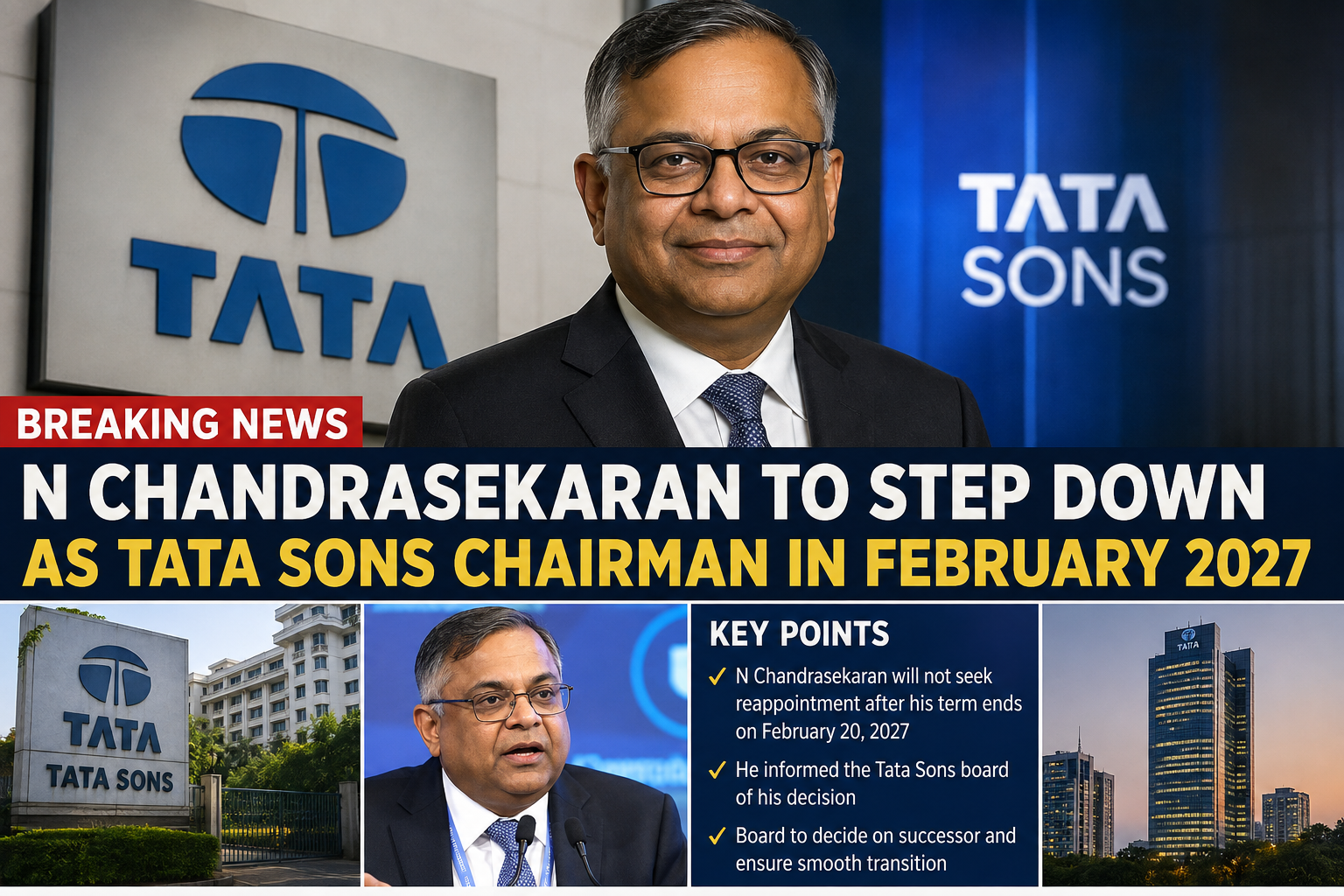
In a major development for corporate India, N Chandrasekaran has decided not to seek reappointment as Chairman of Tata Sons after his current term ends in February 2027.
Chandrasekaran communicated his decision to the Tata Sons board on Wednesday, bringing an end to months of uncertainty over the leadership of one of India’s most influential business groups.
The development comes after the board did not reach a unanimous decision on extending his tenure. Chandrasekaran has been chairman of Tata Sons since January 2017 and has led the group through a period of significant expansion, restructuring and investment across technology, automobiles, aviation, electronics, retail and other sectors.
N Chandrasekaran will continue until February 2027
Importantly, Chandrasekaran is not leaving Tata Sons immediately.
His current term as Executive Chairman is scheduled to end on February 20, 2027. In his communication to the board, he said he would not offer himself for reappointment and asked the board to decide on his successor soon so that there would be adequate time for a smooth transition.
The decision follows a prolonged delay over his proposed reappointment. According to reports, the matter had been under consideration since earlier this year but failed to receive unanimous board support.
That makes the search for the next Tata Sons chairman the next major corporate-governance issue for the Tata Group.
Why Chandrasekaran’s exit matters
The significance of the announcement goes well beyond one leadership change.
Tata Sons is the principal holding company and promoter of the Tata Group, whose businesses span technology, automobiles, steel, power, aviation, hospitality, consumer products and electronics.
Chandrasekaran joined the Tata Sons board in 2016 and became chairman in January 2017. Before taking charge at Tata Sons, he spent three decades at Tata Consultancy Services, including eight years as its CEO and managing director.
During his tenure, the group pursued a strategy centred on simplifying businesses, increasing scale and creating greater synergies across Tata companies.
His departure therefore comes at a sensitive moment, with several major Tata businesses undergoing transformation.
Tata Group faces a crucial leadership transition
The leadership question comes as the Tata Group manages an ambitious investment cycle.
Air India is undergoing a large-scale transformation following its return to Tata ownership, while Tata Electronics has been expanding its manufacturing ambitions. The group is also dealing with challenges across the automotive and global businesses, including Jaguar Land Rover.
Reuters reported that the current tensions have included disagreements over issues such as the future listing of Tata Sons, Air India’s losses and the exit of a minority shareholder.
These issues make the appointment of Chandrasekaran’s successor particularly important.
The next chairman will inherit a group that is considerably more diversified than it was a decade ago, but also one facing large capital commitments and increasingly complex global operations.
Tata Sons chairman N Chandrasekaran’s tenure
Chandrasekaran’s time at the helm has been marked by an aggressive push into new businesses and large-scale investments.
The Tata Group has expanded its presence in areas such as semiconductors and electronics manufacturing, electric mobility, aviation and energy storage, while continuing to strengthen established businesses.
At TCS, Chandrasekaran had already built a reputation as a technology-focused leader. Tata’s official leadership profile says he pursued the group’s “One Tata” strategy around simplification, scale and synergy after becoming chairman.
His tenure has also seen the Tata Group navigate the aftermath of the COVID-19 pandemic, major changes in the global technology sector and substantial investments in new industries.
What happens next?
The immediate focus will now shift to the Tata Sons succession process.
Chandrasekaran has asked the board to move quickly on the leadership decision, signalling that the group wants sufficient time for an orderly transition before his current term expires in February.
The question of who will take over will be closely watched by employees, investors, business partners and the wider Indian corporate sector.
The development is also likely to remain a key talking point ahead of Tata Sons’ upcoming shareholder and board discussions.
For the Tata Group, the challenge will be to ensure that the transition does not disrupt ongoing strategic projects while providing clarity about the conglomerate’s direction for the next phase.
A new chapter for Tata Group
N Chandrasekaran’s decision marks the beginning of a new chapter for Tata Sons.
For nearly a decade, he has been the public face of the group’s strategy and its push into new sectors. Now, the group faces the task of finding a successor capable of balancing Tata’s traditional strengths with the demands of a rapidly changing global business environment.
With his tenure set to conclude on February 20, 2027, the succession process will be one of the most closely watched developments in Indian corporate India over the coming months.
For now, Chandrasekaran remains at the helm. But Wednesday’s announcement has made one thing clear: the Tata Group is preparing for a change in leadership at the top.
About the Author