
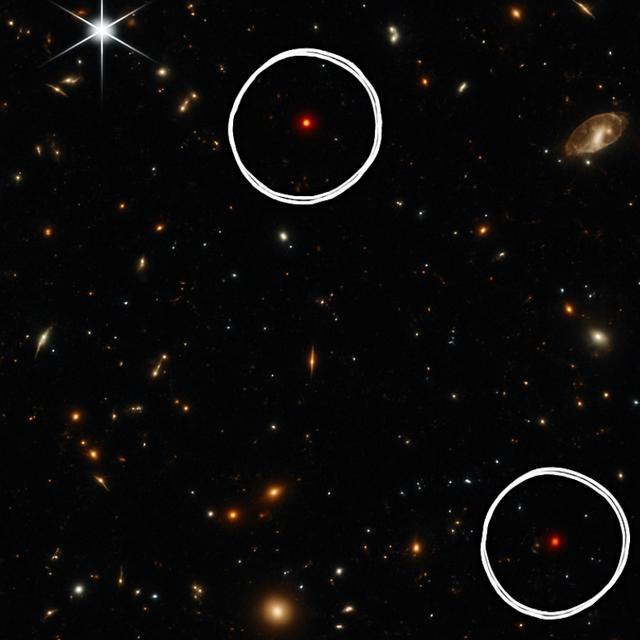
A remarkable cosmic discovery involving Hyderabad-born astronomer Rohan Naidu black hole star is giving scientists a fresh look at how the universe’s earliest black holes may have formed.
Astronomers using NASA’s James Webb Space Telescope (JWST) have identified an extraordinary object known as MoM-BH-1*, a candidate “black hole star” dating to a time when the universe was only about 660 million years old. The findings, published in Nature in August 2026, could help explain one of the biggest mysteries emerging from Webb observations: the strange population of compact objects known as “little red dots.”
Who Is Rohan Naidu?
Rohan P. Naidu is an astronomer whose research focuses on the first galaxies, stars and black holes that emerged after the Big Bang.
Born and raised in Hyderabad, Naidu took an unusual route into astronomy. According to the Center for Astrophysics | Harvard & Smithsonian, he left engineering at 18 and later joined Yale-NUS College before pursuing astronomy and astrophysics. His research has since become closely connected with some of JWST’s most intriguing discoveries.
His work focuses on understanding how the first galaxies appeared, how early black holes grew and how the young universe evolved.
What Is a ‘Black Hole Star’?
The name sounds like science fiction, but the idea is rooted in a serious astrophysical model.
A black hole star is not an ordinary star with a black hole simply orbiting inside it. Instead, scientists are investigating whether a rapidly growing black hole can become surrounded by an extremely dense envelope of gas.
Material falling toward the black hole releases enormous amounts of energy. Dense gas surrounding the central black hole can absorb and reprocess that radiation, creating an object that appears unusually bright and star-like from a great distance.
NASA has also reported strong evidence for this general black-hole-star scenario in other “little red dots,” describing them as rapidly growing black holes surrounded by hot, dense gas cocoons.
MoM-BH*-1: The Cosmic Object Making Headlines
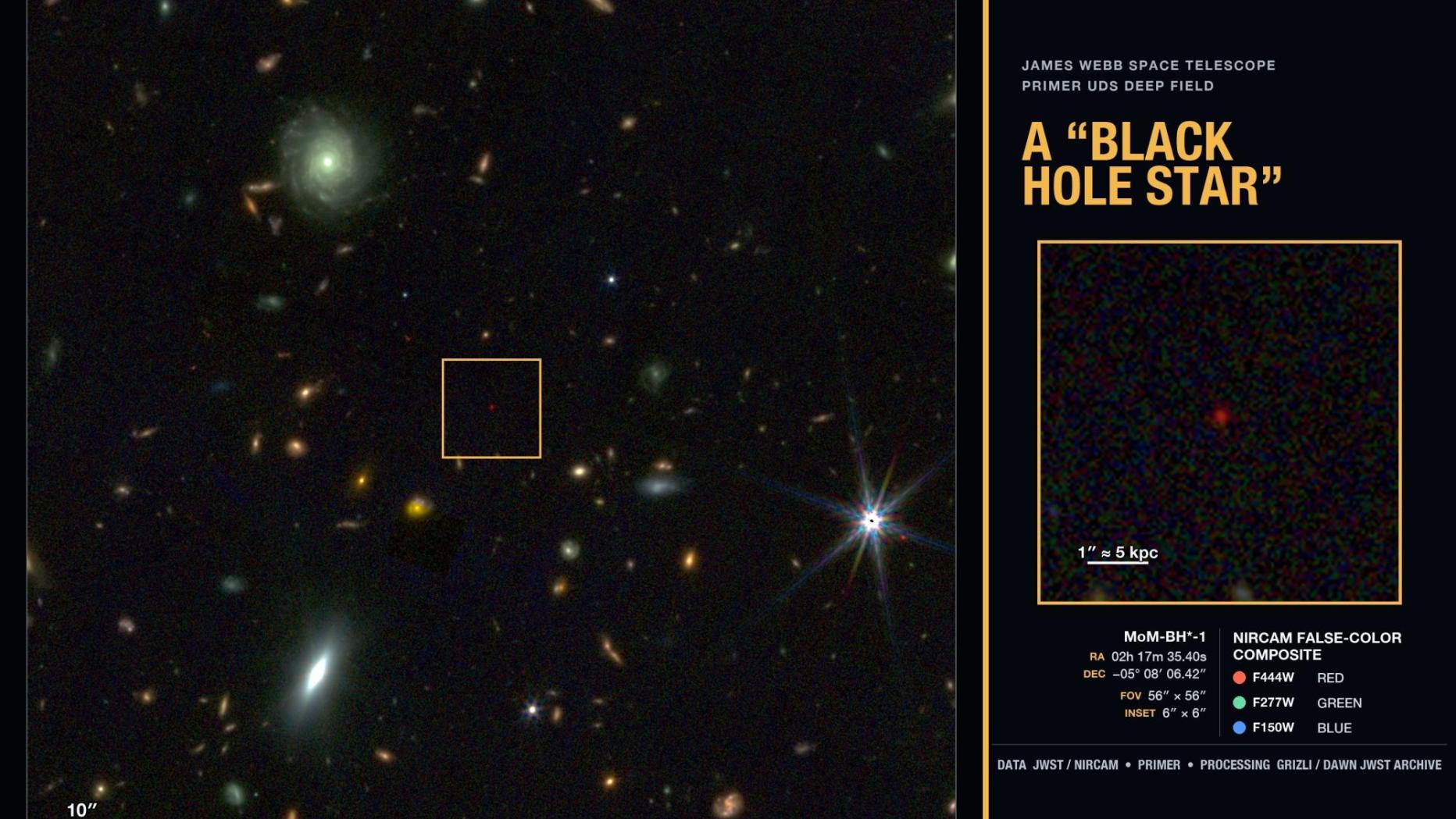
The newly highlighted object, MoM-BH-1*, was detected in observations from the JWST’s Mirage or Miracle survey.
What makes it extraordinary is its combination of extreme brightness, compact appearance and unusual spectral characteristics.
The object is seen at a redshift corresponding to a universe only hundreds of millions of years old. Scientists believe its light could be dominated by material surrounding a massive black hole rather than by a conventional population of stars.
Its unusual spectrum includes a pronounced Balmer break and other features that are difficult to explain with a normal stellar population alone.
That is where the black-hole-star explanation becomes particularly interesting.
Why This Discovery Matters
The early universe has presented astronomers with a major puzzle.
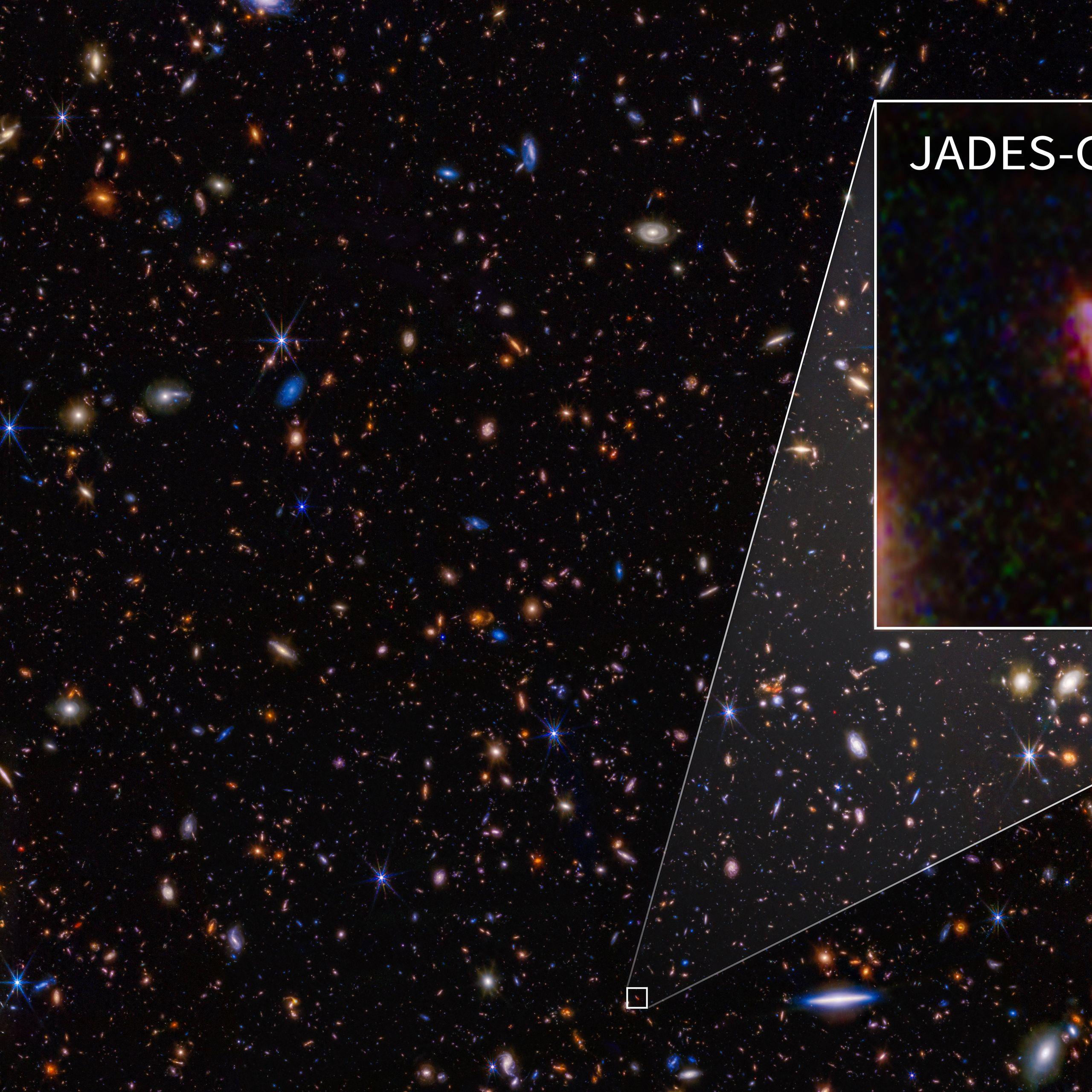
JWST has found surprisingly luminous galaxies and compact red sources at enormous distances. Some of these objects appear to contain black holes that grew far faster than traditional models would easily predict.
Naidu and his collaborators have previously proposed that some “little red dots” could contain black holes hidden inside dense gas envelopes. Their 2025 work presented the black-hole-star model as a possible explanation for the remarkable spectra of these objects.
The latest observations provide another important piece of evidence.
If objects such as MoM-BH*-1 really represent an early stage of black-hole growth, they could help explain how enormous supermassive black holes appeared so early in cosmic history.
Could Black Hole Stars Explain the ‘Little Red Dots’?
That remains one of the biggest questions.
Since JWST began observing the distant universe, astronomers have repeatedly encountered mysterious compact red sources. They are small, extremely bright and difficult to classify using traditional galaxy models.
Research published in 2026 has strengthened the possibility that at least some of these objects are powered primarily by growing black holes surrounded by dense gas. One study led by researchers including Rohan Naidu identified hundreds of black-hole-star-dominated candidates in JWST imaging.
That does not mean every little red dot is a black hole star. Scientists are still testing competing explanations and gathering additional observations.
A New Window Into the Universe’s First Black Holes
The importance of MoM-BH*-1 goes beyond discovering an unusual object.
Astronomers are trying to answer a fundamental question: How did the first supermassive black holes grow so quickly?
The universe was only a fraction of its current age when some of the earliest enormous black holes already existed. Understanding their origins could transform models of galaxy formation and the relationship between galaxies and the black holes at their centers.
For Rohan Naidu and his collaborators, the JWST is providing an unprecedented opportunity to investigate that missing chapter of cosmic history.
And as Webb continues scanning the distant universe, scientists may discover that MoM-BH*-1 is not an isolated curiosity but part of a much larger population of black-hole stars that existed during the universe’s earliest era.
Rohan Naidu Black Hole Star: Key Facts
- Astronomer: Rohan P. Naidu
- Object: MoM-BH*-1
- Telescope: NASA’s James Webb Space Telescope
- Cosmic era: About 660 million years after the Big Bang
- Possible nature: A rapidly growing black hole surrounded by dense gas
- Related mystery: JWST’s “little red dots”
- Research significance: May help explain the early growth of massive black holes
The Bottom Line
The “black hole star” discovery is another reminder that the early universe was far stranger—and more complex than astronomers once imagined.
For Indian-origin astronomer Rohan Naidu, the research adds another milestone to a career focused on uncovering the universe’s earliest galaxies and black holes. The real breakthrough may come if future JWST observations confirm that MoM-BH*-1 represents a broader class of objects.
For now, scientists have a compelling new cosmic clue and a much bigger mystery to solve.
Sources: NASA, MIT, Nature, Center for Astrophysics | Harvard & Smithsonian, Rohan Naidu’s research publications.
About the Author