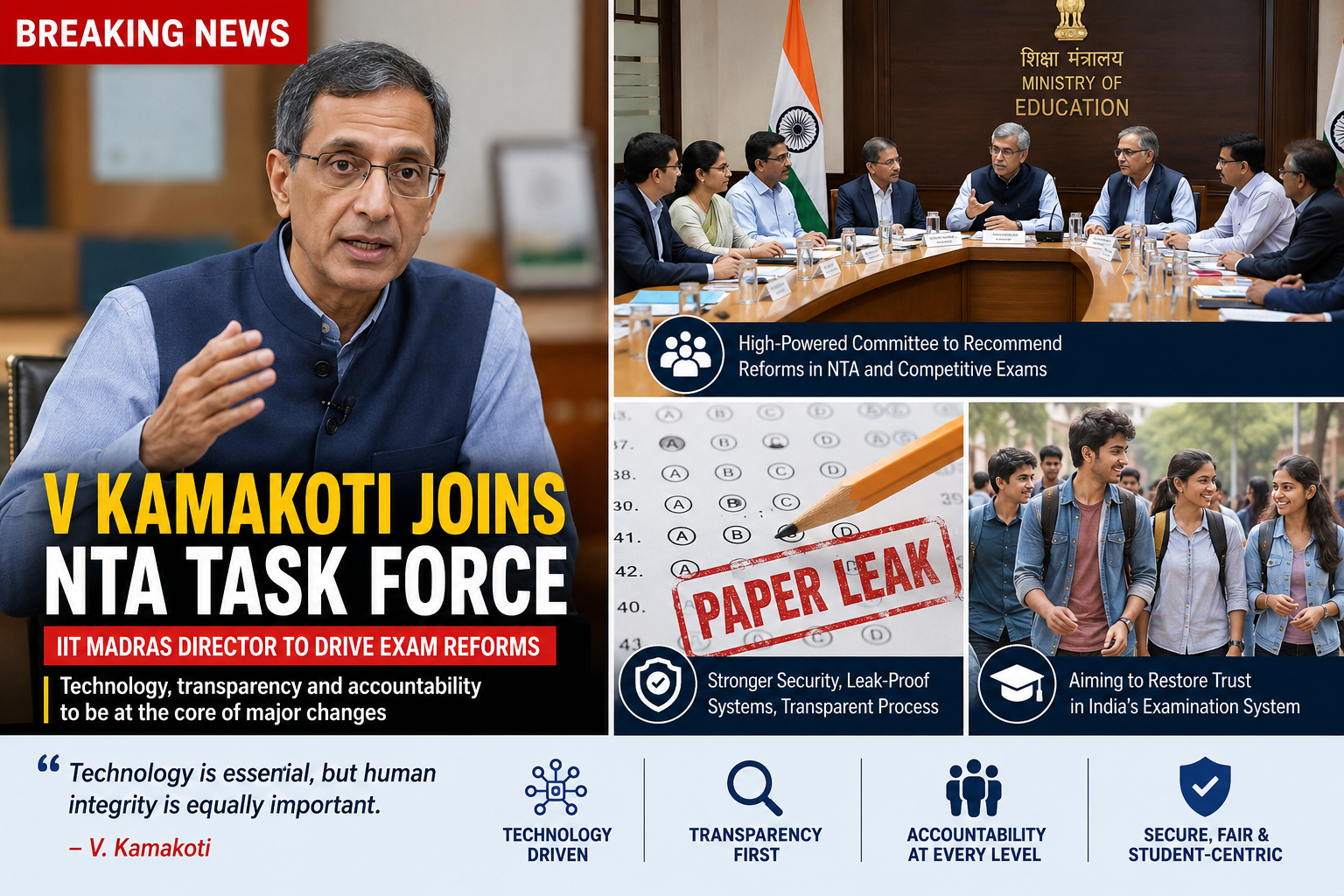
India’s examination system could soon witness its biggest overhaul in years as IIT Madras Director Prof. V. Kamakoti, a member of the Centre’s newly constituted V Kamakoti NTA Task Force, has outlined an ambitious vision focused on technology, transparency, and accountability.
The task force, announced by Prime Minister Narendra Modi and led by Infosys co-founder Nandan Nilekani, has been formed to recommend structural reforms for the National Testing Agency (NTA) following widespread concerns over exam integrity and paper leak allegations.
V Kamakoti Highlights Technology as the Key to Restoring Trust
Speaking after joining the committee, Prof. V. Kamakoti stressed that technology must play a central role in managing India’s large-scale competitive examinations.
According to him, today’s entrance examinations involve millions of candidates across thousands of centres, making advanced digital systems, stronger verification mechanisms, and transparent evaluation processes essential for maintaining public confidence.
He emphasized that reforms should not only improve operational efficiency but also rebuild the trust of students and parents who expect a fair examination process.
Human Integrity Remains the Biggest Challenge
While advocating greater use of technology, Kamakoti also cautioned that digital tools alone cannot eliminate malpractice.
He noted that if individuals involved in preparing examination papers misuse their responsibilities, no encryption system can completely prevent leaks. According to him, safeguarding the integrity of question paper setters, invigilators, and administrators remains equally important.
The committee is therefore expected to recommend both technological safeguards and stronger institutional accountability.
Why the NTA Task Force Was Formed
The Central Government constituted the task force after growing concerns over the credibility of national entrance examinations.
Prime Minister Narendra Modi announced that the committee will recommend reforms aimed at creating a more secure, transparent, and technology-enabled examination ecosystem. The government has also indicated that legislative measures and stricter legal provisions will complement these reforms.
Members of the High-Powered NTA Reform Task Force
The committee brings together experts from technology, education, security, administration, and logistics, including:
- Nandan Nilekani (Chairperson)
- Former ISRO Chairman S. Somanath
- Former Intelligence Bureau Director Tapan Deka
- IIT Madras Director Prof. V. Kamakoti
- Former Education Secretary Anita Karwal
- Logistics expert Amrit Lal Meena
What Changes Could Students Expect?
Although the committee has only begun its work, discussions indicate that several reforms may be explored, including:
- Advanced digital security for examinations
- Stronger candidate verification systems
- Independent audits of examination processes
- Greater transparency in evaluation
- Multi-stage reforms implemented over the short, medium, and long term
Officials say the objective is to create a robust examination framework capable of handling millions of candidates without compromising fairness or security.
Why This Matters
The formation of the NTA reform task force represents one of the most significant attempts in recent years to restore credibility to India’s competitive examination system.
With experts like Prof. V Kamakoti NTA Task Force advocating a balanced approach that combines advanced technology with stronger human accountability, students across the country will be watching closely as recommendations begin to emerge.
The committee’s report is expected to shape the future of national entrance examinations, influencing how exams are conducted, monitored, and secured in the years ahead.
About the Author