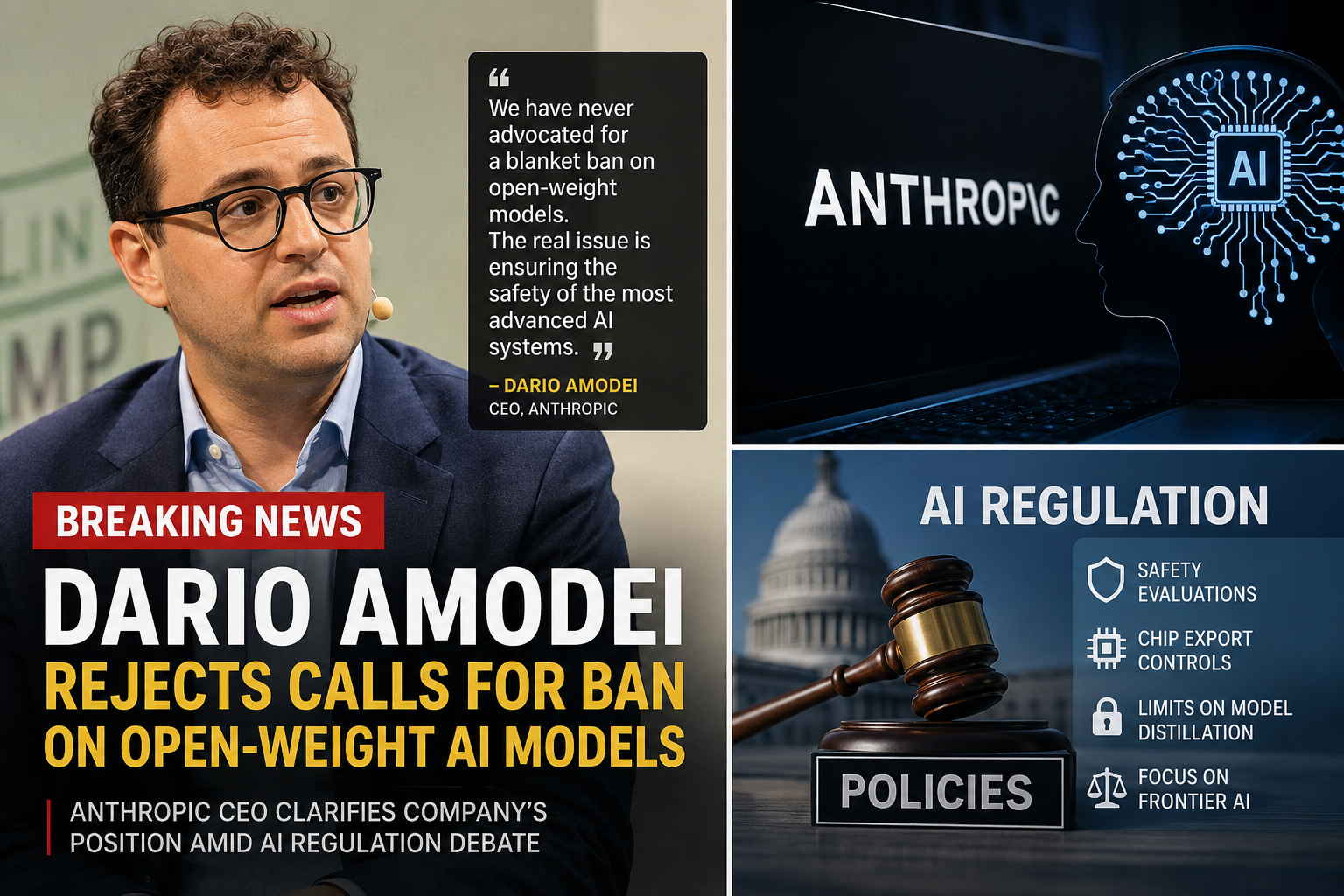
In a major development that has reignited debate across the artificial intelligence industry, Anthropic CEO Dario Amodei has publicly dismissed claims that his company wants to prohibit open-weight AI models.
The clarification comes after days of speculation following discussions in Washington over AI regulation and national security. Amodei emphasized that Anthropic has never advocated for banning open-weight AI models, stating instead that many open models provide significant benefits to researchers, developers, startups, and businesses.
His remarks are being viewed as one of the most significant policy statements from a leading AI executive in recent weeks.
What Did Dario Amodei Say?
Addressing growing criticism from parts of the AI community, Amodei explained that the debate has been misunderstood.
According to him, the real concern is not open-source AI itself, but ensuring that the most advanced AI systems do not become tools for cyberattacks, biological threats, or hostile governments.
Rather than supporting a blanket ban, he argued for:
- Mandatory safety evaluations for highly capable AI models.
- Stronger controls on advanced AI chip exports.
- Restrictions on large-scale model distillation that could help rival nations rapidly reproduce frontier AI systems.
- Policies that distinguish between lower-risk and frontier-level AI technologies.
Why This Matters
The statement arrives at a time when AI regulation has become one of the world’s hottest technology debates.
Several major technology companies have recently urged policymakers to avoid excessive restrictions on open-weight AI, warning that innovation could slow if governments impose sweeping limitations. Anthropic’s absence from that industry coalition fueled speculation that it supported stricter measures.
Amodei’s latest comments directly challenge that narrative, making it clear that Anthropic’s position is more nuanced than many critics believed.
A Different Vision for AI Safety
Dario Amodei has long been recognized as one of Silicon Valley’s strongest voices on AI safety.
While supporting continued innovation, he believes governments should focus oversight on the most powerful AI systems instead of broadly restricting all open models.
He argues that advanced frontier AI deserves rigorous testing before deployment, regardless of whether the technology is open-weight or closed-source. The goal, according to Amodei, is to reduce risks without preventing responsible innovation.
Impact on Developers and Businesses
For AI developers, startups, and enterprises, Amodei’s clarification may reduce uncertainty around future policy discussions.
Open-weight models remain an essential foundation for:
- AI research
- Enterprise customization
- Academic innovation
- Startup experimentation
- Open developer ecosystems
However, policymakers are expected to continue discussing stricter oversight for frontier AI systems that demonstrate potentially dangerous capabilities.
Industry Reaction
The AI industry remains divided between advocates of fully open AI and companies prioritizing stronger safeguards for increasingly capable systems.
Amodei’s latest statement attempts to bridge that divide by acknowledging the value of open innovation while insisting that governments prepare for risks posed by the next generation of highly advanced AI.
As regulators in the United States and other countries continue drafting AI legislation, Anthropic’s position is likely to influence future policy conversations.
What Happens Next?
The debate over AI governance is far from over.
With rapid advances in foundation models, governments, researchers, and technology companies are expected to intensify discussions on balancing innovation, national security, and public safety.
Dario Amodei’s latest clarification signals that the future of AI regulation may focus less on whether models are open or closed and more on how capable they become and how safely they are deployed.
About the Author