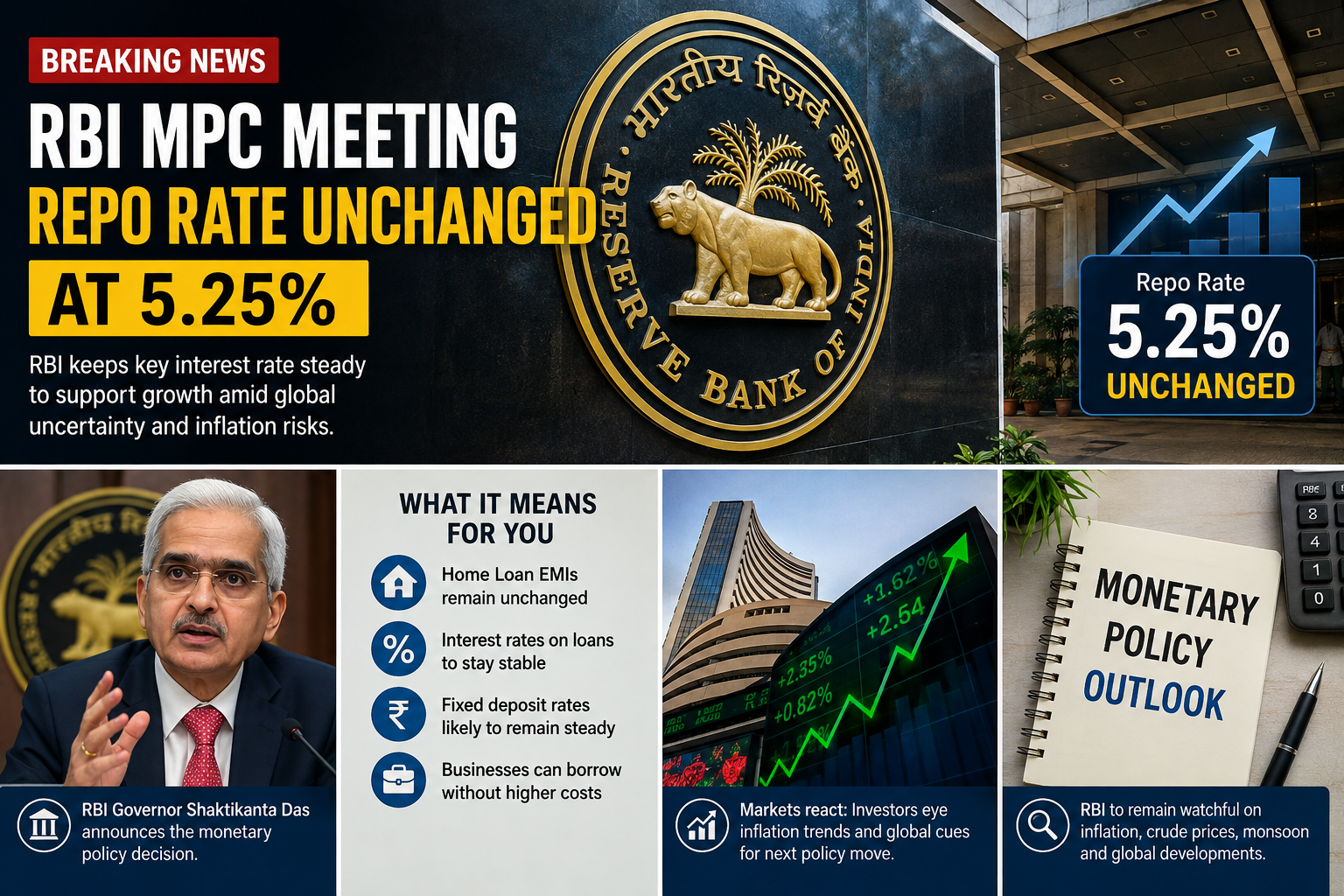
In a widely anticipated decision, the Reserve Bank of India (RBI) has kept the repo rate unchanged at 5.25%, maintaining its cautious approach as the country navigates global economic uncertainty and inflation risks. The decision was announced after the three-day meeting of the Monetary Policy Committee (MPC), offering stability for borrowers, businesses, and financial markets.
The unanimous decision signals that the central bank is prioritizing economic stability while closely monitoring inflation, crude oil prices, and global geopolitical developments before making any further changes to interest rates.
RBI Repo Rate Today: What Changed?
The RBI has decided to leave the policy repo rate unchanged at 5.25%, meaning banks are unlikely to make immediate changes to lending or deposit rates.
For millions of home loan borrowers, this comes as welcome news because:
- Existing home loan EMIs are expected to remain unchanged.
- Personal loan and vehicle loan interest rates are likely to stay stable.
- Businesses can continue borrowing without facing higher financing costs.
- Fixed deposit rates may also remain broadly unchanged in the near term.
Why Did RBI Hold Interest Rates?
Although inflation has remained relatively manageable, the RBI highlighted several global risks that continue to create uncertainty.
Key concerns include:
- Rising international crude oil prices
- Global geopolitical tensions
- Weather-related risks affecting food inflation
- Volatility in international financial markets
Instead of rushing into a rate hike or cut, the central bank has chosen a “wait-and-watch” strategy until incoming economic data provides greater clarity.
What This Means for Home Loan Borrowers
If you already have a floating-rate home loan linked to the repo rate, there is unlikely to be any immediate change in your monthly EMI.
Borrowers planning to purchase a home may also benefit from continued stability in lending rates, helping maintain affordability during the upcoming festive season.
Banks may continue offering competitive loan products, but significant reductions in borrowing costs are unlikely unless the RBI begins cutting rates in future policy meetings.
Impact on Fixed Deposits and Savings
Deposit holders should not expect major changes immediately.
Since policy rates remain unchanged:
- Fixed deposit interest rates are expected to stay near current levels.
- Savings account rates are unlikely to witness significant revisions.
- Investors seeking stable returns may continue to find FDs attractive if banks maintain existing rates.
Stock Market Reaction
Financial markets were largely prepared for the RBI’s decision, as economists had broadly expected no change in policy rates.
Banking stocks, real estate companies, and NBFCs will now closely track future inflation data and RBI commentary for clues on the next policy move. A prolonged period of stable interest rates could provide support to interest-sensitive sectors.
What’s Next for RBI?
Economists believe future monetary policy decisions will depend on:
- Inflation trends
- Global crude oil prices
- Monsoon performance
- Food inflation
- International economic developments
If inflation remains under control, the RBI could continue maintaining the current rate. However, any sharp increase in inflationary pressure may force policymakers to reconsider their stance later in the financial year.
Final Take
The RBI’s latest monetary policy decision delivers continuity rather than surprise. By keeping the repo rate at 5.25%, the central bank has chosen stability over aggressive policy action, giving borrowers, businesses, and investors a predictable interest-rate environment while remaining alert to global and domestic risks.
About the Author